
Many organisations say they value judgement, empathy and creativity.
Yet their work is often still designed around speed, volume and constant availability.
Yesterday, an announcement from EY caught my attention…
EY US is investing US$100 million in a new employee rewards program recognising the skills, behaviours and outcomes it believes will matter in the future. Hopefully it’s a signal of what’s to come elsewhere too!
Alongside AI experimentation and technology adoption, the program rewards capabilities including adaptability, learning, business acumen, leadership, collaboration and innovation. That’s right – many of the human capabilities we know are becoming increasingly important ‘performance multipliers’ in an AI-enhanced world are now being explicitly tied to a reward.
In my last newsletter, I mentioned that this skills shift isn’t only asking people to develop new capabilities, but asking organisations to reconsider what capability they value in the first place. And I think this act by EY is a step in the right direction.
The Changing Definition of Professional Value
As technology becomes more capable, technical expertise and AI fluency are highly valued. But over time, I suspect much of that fluency will increasingly become part of the professional baseline – much like using the internet is today…
That makes the capabilities that differentiate human contribution hugely valuable.
And I see this reflected in the rooms I work in. When I ask leaders and teams which capabilities their future selves will need, human capabilities consistently come up.
This shift towards human capability requires deliberate development and some unlearning. For a long time, many organisations did not recruit, develop or reward these capabilities. They were treated as the ‘soft stuff’, useful perhaps, although they rarely carried the same weight as technical expertise, efficiency or output.
I certainly don’t remember empathy featuring prominently in the capability frameworks I encountered earlier in my corporate career. In fact, I remember some of the more human strengths I brought to teams being laughed at!
Fast forward to today, and many people are (still) navigating back-to-back meetings, relentless workloads and constant demands on their attention. So even as we recognise these capabilities matter more, where is the room to develop and use them?
Because human capabilities still need to be developed, practised and exercised.
And that creates a very practical challenge.
Reward and Room Need to Match
We can add judgement, empathy, creativity and leadership to our capability frameworks. We can invest in developing them. We can reward people for demonstrating them.
But everyday work also needs to give people enough room to put those capabilities into practice.
- Judgement requires space to think.
- Empathy requires space to listen.
- Leadership requires space to notice people.
- Creativity requires space to explore.
- Relationships require space to build.
When roles, workloads and expectations consume all available capacity, we send mixed signals. We tell people human capabilities matter, while designing work that makes them difficult to demonstrate.
We can’t ask people for more human contribution while designing their work for maximum human output.
And this is where AI creates an interesting opportunity.
Creating Room for Human Contribution
I think about the AI opportunity in three ways:
- Automation — How do we do this faster?
- Augmentation — How do we do this better?
- Amplification — What can we now do that matters more?
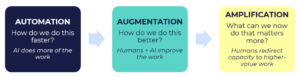
Each creates value in a different way. Yet Amplification requires a deliberate choice about where the capacity created by technology goes next. Efficiency isn’t the problem. But stopping at efficiency is the missed opportunity.
Many organisations are already exploring where AI can save time and improve output.
The next question is what we choose to do with the capacity created. Could it give people more time…
- To think?
- To listen?
- To build relationships?
- To make better decisions?
- To solve harder problems?
- To learn?
- To lead?
- To recover, finish early or even work one less day?
Because capacity created doesn’t automatically become value created.
If every efficiency gain simply becomes more work, we may create greater output without creating greater value.
If we want people spending more time exercising judgement, building relationships, solving complex problems and leading others, roles and priorities may need to change.
So might workloads, performance measures and leadership expectations.
People pay attention to what organisations make room for not just what they say matters.
Knowing where you want people to spend their capacity is one step. Their roles, goals, measures and managers determine whether they can.
Which brings me back to EY…
Changing what we reward tells people where value is moving.
Changing how work is designed gives people the opportunity to create it.
The two need to reinforce each other.
As organisations explore the opportunities AI creates, the conversation needs to shift beyond the technology and into how work is actually designed.
Rewards programs can point people towards the capabilities an organisation values. But work design determines whether those capabilities have room to show up.
As AI and other tools create more capacity, organisations need to decide deliberately where to reinvest it.
So, if AI created meaningful capacity in your organisation tomorrow, have you designed work so your people could use it well?