Something has shifted, and most of us have felt it before we’ve had a chance to name it.
A financial adviser told me recently that his clients are turning up with portfolios they’ve already built using AI. An ETF mix, rebalancing logic, even a risk score. Not finished portfolios, but good enough to start the conversation somewhere completely different.
A few weeks ago, I even walked into a GP appointment having already run my symptoms through an AI tool. It had given me a list of possible diagnoses and questions to ask. The consultation didn’t begin with information but interpretation, and a weighing of the trade-offs and deciding what to do next.
And I’m hearing the same from lawyers, sales people, mortgage brokers, HR professionals, the list goes on. Clients, direct reports, and other stakeholders are arriving having already done the research, explored their options and asked AI the obvious questions.
At first glance, it could feel like expertise is becoming less valuable. But I don’t think that’s what’s happening at all…
I think the starting point of value has shifted.
The Shift
For decades, our value came from knowing, doing, producing and processing information. Whoever held the knowledge held the power.
Today, information is increasingly accessible to everyone, instantly, and at scale. So providing information is no longer where the greatest value lies.
AI therefore has raised the entry point for professionals. Clients are no longer paying simply to access information. They’re paying for interpretation, confidence and sound judgement about what to do with it.
Now every major technological revolution has changed where value is created – steam power, electricity and the internet all did it. AI is no different – it’s not removing value, it’s just relocating it.
We’re entering a world where intelligence is becoming abundant. And whenever something becomes abundant, something else becomes more valuable. That something is human capability – the ability to weigh up options, explore context, and decide when the right answer isn’t obvious.
So perhaps the question is no longer, “What do you know?” Instead, it’s, “What can you help someone do with what they already know?”
Where Value Now Lives
I’ve started thinking about this shift as The Human Value Ladder.
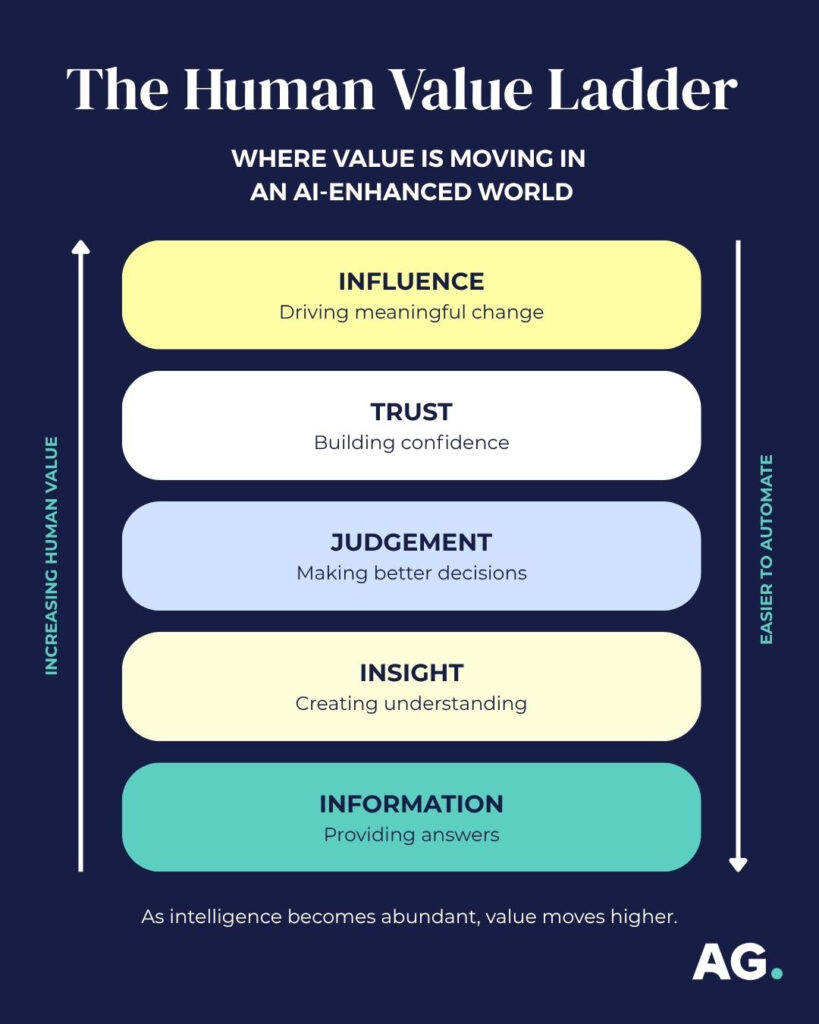
And I think every profession is already moving up this ladder.
Take the financial adviser…
AI can help construct a portfolio. The adviser helps clients understand whether it’s right for their goals, their appetite for risk and their future. More importantly, they give people the confidence to act, and the accountability of someone who will stand behind the recommendation.
Take the doctor…
AI can suggest possible diagnoses. The doctor sees the whole person, their context, environment, and what the data can’t, recognises what doesn’t quite fit and carries the responsibility for the decision.
Take the lawyer…
AI can help draft a contract. The lawyer negotiates, anticipates risk, understands the commercial context and applies judgement that no model can replicate. The information isn’t disappearing, it’s simply no longer where the greatest value begins.
AI amplifies capability but it doesn’t create it. Which means differentiation shifts to judgement, not the volume of information you can produce.
In fact, the best professionals may become even more valuable in the future. AI will strip out the lower-value parts of their work and free them up to spend more time where they create the greatest value.
That won’t be true for everyone – some roles will be pressure-tested on price and time, which is exactly why they need to be redesigned rather than left to chance.
But those who move up the ladder can apply wisdom rather than produce information. They can focus on more meaningful work, which delivers more value for clients and more satisfaction for them.
What This Means For All Of Us
This isn’t just a story for advisers, lawyers or doctors. Whether you’re leading a team, serving clients, part of a consultancy or building a business, the same shift applies.
Future value won’t come from protecting access to your expertise. It will come from deliberately building the capabilities that AI can’t automate – judgement, adaptability, creativity, emotional intelligence, resilience, trust, leadership.
These are the capabilities organisations will increasingly value, clients will increasingly pay for, and teams will increasingly follow. Future-proofing is about building the capabilities that increase your value as work changes, not protecting your current role at all costs.
And perhaps the journey we’re all on can be summed up in three sentences.
Yesterday, people came to you for answers.
Today, they arrive with answers.
Tomorrow, they’ll choose you for your judgement.
One of the questions I’m asked most often is, “Will AI replace me?” I think there’s a better question. If everyone can increasingly access the same intelligence, “Where does your value now begin?”
AI is competing with the lowest-value parts of your expertise. And that creates a huge opportunity. The opportunity to spend less time producing information, and more time creating the kind of value only humans can. This shift isn’t just changing how we work. It’s already changing how organisations hire, develop talent, price expertise and define value.
That’s exactly the conversation I’m having right now – not about AI itself, but about how to redesign roles, capability and leadership for where value is moving.
So, where do you create the most value today… and where do you need to move next?